 Kelvin background.
Penzias and Wilson discovered the CMBR in 1965 using a radio telescope,
and subsequently received the Nobel Prize for this discovery.
This background radiation has wavelength
Kelvin background.
Penzias and Wilson discovered the CMBR in 1965 using a radio telescope,
and subsequently received the Nobel Prize for this discovery.
This background radiation has wavelength
 mm.
The energy density of the CMBR is about
4.0 x 10⁻¹⁴ J/m3.
What is the rms electric field strength of the CMBR?
ANSWER:
If
mm.
The energy density of the CMBR is about
4.0 x 10⁻¹⁴ J/m3.
What is the rms electric field strength of the CMBR?
ANSWER:
If
 J/m3, then

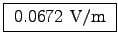 .
(The wavelength, while interesting, is irrelevant to the question.)
.
(The wavelength, while interesting, is irrelevant to the question.)

- Show that these satisfy the wave equation (9.2).
ANSWER:
When we're taking the spatial derivatives, the t-dependent factor
is just part of the amplitude, and vice versa. Thus
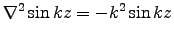 and
and
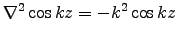 ;
;
 and
and
 ; so
; so
 and similarly for
  .
But
.
But
![$(-k^2 + \omega^2/c^2) = -k^2[1-(\omega^2/k^2)/c^2] = 0$](img13.gif) ,
since
,
since  . Thus
 and similarly for .
- Show that we must also have
and E0 = c B0.
ANSWER:
Since
is a universal property of all solutions of
The Wave Equation (TWE), that's a given.
Applying FARADAY'S LAW,
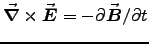 , gives
 or
or
 .
Dividing out the common factor
.
Dividing out the common factor
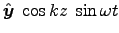 gives
gives
 or (since )
 .
.
- Show that the time-averaged power flow
across any area will be zero.
ANSWER:
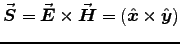
 .
Looking only at the t-dependence to get the time average, we note that
.
Looking only at the t-dependence to get the time average, we note that
 which averages to zero.
- Show that the Poynting vector will also be zero,
i.e. there is no net energy flow.
ANSWER:
I must apologize for a defective question.
[The hazards of using someone else's problem!]
As explained above,
 . This is only zero where
  ,
i.e. at z=0 and
,
i.e. at z=0 and  (where n is any integer).
That is, for
(where n is any integer).
That is, for
 . At any other position,
  oscillates in the
  direction,
averaging to zero.
direction,
averaging to zero.
 direction.
Prove that this must be so.
[Hint: Let the polarization vectors of
the reflected and transmitted waves be
direction.
Prove that this must be so.
[Hint: Let the polarization vectors of
the reflected and transmitted waves be

and prove from the boundary conditions that
 .]
ANSWER:
We must have
.]
ANSWER:
We must have
 continuous across the boundary.
Since the normal direction is
continuous across the boundary.
Since the normal direction is
 ,
is constituted of x and y components.
Thus
,
is constituted of x and y components.
Thus
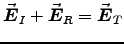 or
or
 [1] and
 [2].
Similarly,
[2].
Similarly,
 must be continuous across the boundary,
and, as always,
must be continuous across the boundary,
and, as always,
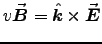 , giving
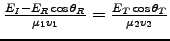 [3] and
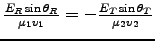 [4].
If
[4].
If
 ,
Eq. [4] reads
,
Eq. [4] reads
 ,
which we can combine with Eq. [2] to conclude that
,
which we can combine with Eq. [2] to conclude that
 ,
which can be true only if ET = 0 (trivial case) or
,
which can be true only if ET = 0 (trivial case) or
 (mod
(mod  ). Equation [2] then
also requires
). Equation [2] then
also requires
 (mod ).
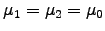 .)
ANSWER:
FRESNEL'S EQUATIONS read
.)
ANSWER:
FRESNEL'S EQUATIONS read

where
![${\displaystyle \alpha \equiv {\cos \theta_T \over \cos \theta_I}
= {\sqrt{1 - . . .
. . . sqrt{1 - \left[{n_1 \over n_2} \sin \theta_I\right]^2}
\over \cos \theta_I} }$](img51.gif) and
and
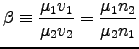 .
In this case
.
In this case  (we assume the light is entering
the diamond rather than emerging) and
(we assume the light is entering
the diamond rather than emerging) and
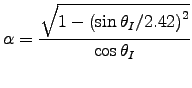 .
You can use your favourite spreadsheet or other plotting software
to produce the graph below. (I used http://musr.org/muview/,
a free Java spreadsheet applet we built at TRIUMF.)
.
You can use your favourite spreadsheet or other plotting software
to produce the graph below. (I used http://musr.org/muview/,
a free Java spreadsheet applet we built at TRIUMF.)
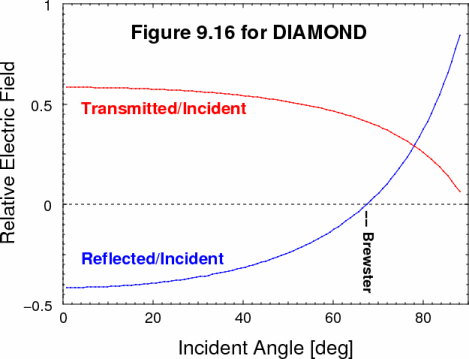
- the amplitudes at normal incidence;
ANSWER:
For
 ,
,  , giving
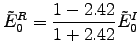 or
or
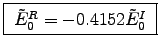 and
and
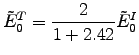 or
or
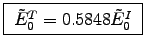 .
.
- Brewster's angle;
ANSWER:
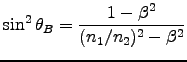
 or
or
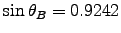

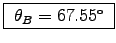 .
.
- and the "crossover" angle at which
the reflected and transmitted amplitudes are equal.
ANSWER:
Rather than try to read this off the graph, let's calculate it exactly:
The condition is
 or
or
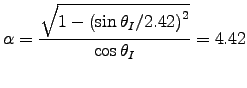 or
or
 or
or
 or
or
 or
or
 or
or
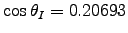
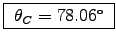 .
.
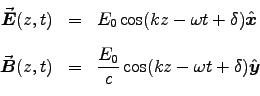
ANSWER: Recall Eq. (8.19) on p. 352:

Here
 where
where
 and
and
 where
where
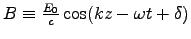 = E/c,
so all off-diagonal elements are zero. We have
= E/c,
so all off-diagonal elements are zero. We have
 or T11 = 0,
 or T22 = 0 and
 or (only nonzero element!)
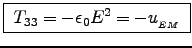 .
.
In what direction does this EM wave transport momentum?
Does this agree with the form of the Maxwell stress tensor
you just deduced?
ANSWER:
If Tij represents the force per unit area acting in the
 direction on a surface whose normal is in the
 direction, then the diagonal elements are
pressures and T33 is the radiation pressure
on a surface normal to
direction, then the diagonal elements are
pressures and T33 is the radiation pressure
on a surface normal to  . In the same way
-T33 represents the the momentum current density
transported by the fields, and is (as expected) in the same
direction as
. In the same way
-T33 represents the the momentum current density
transported by the fields, and is (as expected) in the same
direction as  and is, in fact, equal to
  .
.
![\begin{displaymath}
\Vec{E}(r,\theta,\phi,t) = {A \sin\theta \over r} \left[
. . .
. . . ight) \sin \left( k r - \omega t \right)
\right] \Hat{\phi}
\end{displaymath}](img90.gif)
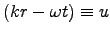 in your calculations.]
 obeys all four of Maxwell's equations,
in vacuum, and find the associated magnetic field.
ANSWER:
Since
obeys all four of Maxwell's equations,
in vacuum, and find the associated magnetic field.
ANSWER:
Since
 and E does not depend on
  ,
GAUSS' LAW reads (in spherical coordinates)
,
GAUSS' LAW reads (in spherical coordinates)
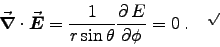

![\begin{displaymath}\hbox{\sf Now, ~ }
\DbyD{E}{\theta} = {A\cos\theta \over r} . . .
. . . r k r } \sin u \right]
= E \; {\cos\theta \over \sin\theta}
\end{displaymath}](img97.gif)


![\begin{displaymath}\hbox{\sf so ~ }
\Curl{E} = {A\over r^2} \left\{ 2\cos\theta . . .
. . . \over kr} \right) \sin u \right]
\Hat{\theta} \right\} \; .
\end{displaymath}](img100.gif)
![\begin{displaymath}
\Vec{B} = - \int \left( \Curl{E} \right) dt
= - {A\over r . . .
. . . ( kr - {1 \over kr} \right) S \right]
\Hat{\theta} \right\}
\end{displaymath}](img101.gif)

![\begin{displaymath}
\hbox{\sf Thus ~ }
\Vec{B} = {A\over c k r^2} \left\{ 2\c . . .
. . . - {1 \over kr} \right) \cos u \right]
\Hat{\theta} \right\}
\end{displaymath}](img103.gif)
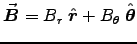 where
where
![\begin{displaymath}
B_r = {2A\cos\theta \over c k r^2} \left[ \sin u
+ { 1 \ov . . .
. . . sin u
- \left( kr - {1 \over kr} \right) \cos u \right] \; .
\end{displaymath}](img105.gif)

![$\displaystyle {2A\cos\theta \over c k r^2}\DbyD{}{r}\left(\sin u
+ { 1 \over k . . .
. . . k r} + k r \right) \cos u \right]
\DbyD{}{\theta}\left(\sin^2\theta \right) \cr$](img107.gif)
![${\displaystyle
\Curl{B} = {1\over r}\left[\DbyD{}{r}\left(rB_\theta\right)
- \DbyD{B_r}{\theta}\right]\Hat{\phi} }$](img108.gif) or
or

![$\displaystyle {1\over r} \left\{ {A\sin\theta \over c k r^2} \left[
\sin u - \left( kr - {1 \over kr} \right) \cos u \right] \right. \cr$](img110.gif)
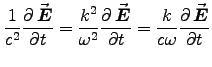
![$\displaystyle {k \over c \omega} {A \sin\theta \over r} \DbyD{}{t} \left[
\cos . . .
. . . \omega} \left[
\omega \sin u + \omega {\cos u \over kr} \right]
\Hat{\phi} \cr$](img112.gif)
 .
Does
.
Does 

 ,
,  and
and  oscillate
in time, but only the first averages to zero;
the other two average to
oscillate
in time, but only the first averages to zero;
the other two average to  ,
but their difference does average to zero. Thus
,
but their difference does average to zero. Thus

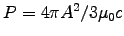
 over a spherical surface
to determine the total power radiated.
over a spherical surface
to determine the total power radiated.
 .]
ANSWER:
.]
ANSWER: 
